


A sense of feeling of anticipation. Visible is the frosty air coming from my fellow runners as they do the "about to run" wiggle on the start line.
A rapid twitch of the hips.
I'm at my local weekly parkrun event and I'm serious. It's almost time...
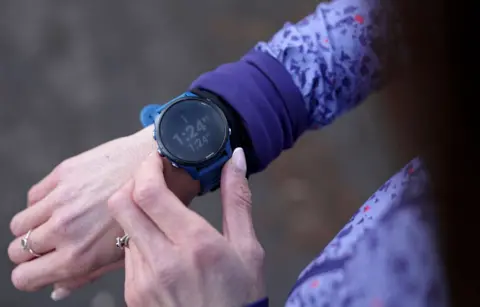
Oh, hang on. I need to start my watch. So does the runner next to me.
The person behind us sighs. I refuse to go until… done! Signal acquired, and I'm running.
Amidst the crowd, it's hard to spot a person without a fitness tracker on it. And this extends beyond us runners who wear them.
This is a booming, multi-billion dollar market. Brands like Samsung Galaxy are prevalent, featuring an wide selection of diverse versions to fit a spectrum of needs. Depending on how high tech the watch you select, costs can start from £100 to thousands of pounds.
"I find it infuriating, I'm unable to stop checking."
"It comforts me… It feels like a friend guiding me."
"Stop telling me I've had a restless night."
A handful of the comments I've received from like-minded tracker enthusiasts when I ask what they their opinion is on theirs.
The Monitoring Conundrum
My feelings on mine? Right now, annoying. It's telling me my speed is wrong, making me wonder whether the overhead branches I'm running below are interfering with my GPS connection.
Countless individuals of us fasten these little devices onto our wrists and use them 24/7, ostensibly comfortable with the fact they're constantly tracking us.
Gone are the days when we depended on them only to give us an idea of our step count. Currently, they can track our sleep quality, stress levels, heart rate variability (HRV), our body battery.
It's difficult to find a bodily function they fail to monitor.
But do they do what they claim to do? And are the statistics we analyse a accurate representation of reality? Do they boost our daily wellness, or do the multitude of readings and cheerleading alerts just add to our daily stresses?

A Love-Hate Relationship
"I do get a a little preoccupied with mine," a wearer admits.
While she appreciates how her device tracks her workouts, she finds some of its other features "overwhelming" at times - a feeling initially realised during a pregnancy.
Prior to discovering she could adjust the settings, her smartwatch repeatedly informed her she was being insufficiently active enough. Now, the watch keeps telling her she's had a restless night.
"I am caring for a infant, there's no point to be informed I'm tired," she says. "I know that only too well."
Why doesn't she just take it off?
"I suppose I could, I suppose, but I'm in this push-pull dynamic with it," she continues. "I appreciate it for its fitness insights, I sometimes question whether the myriad other functions it can now do is perhaps overkill for me."
Inside the Device
Different brands of smartwatch has its own unique way of measuring your health metrics and processing your data, but the vast bulk use sensors on the back of the watch.
They usually project tiny, coloured LED lights onto your arm which can observe blood flow, identifying your BPM. More advanced devices measure changes in the bioimpedance that flows through the skin to get an idea of your recovery state.
Expert Perspectives
A data scientist says that overall for smartwatches, it's a "delicate equilibrium" - while the ever-evolving tech could potentially aid early diagnosis, "identifying issues before we show symptoms", it could also turn us device users into the "anxious healthy".
He points out that some of the latest wearables can carry out tests like electrocardiograms (ECGs), which constantly monitor how normal the heart is. They can alert if someone is experiencing an irregular rhythm, where there is abnormal electrical activity in the heart causing an irregular heartbeat.
This does not mean someone is about to have a cardiac event, but it can give an advance notice they might be more vulnerable of a heart problem in the long term.
But how to interpret these readings is complex. The expert concerns that as further capabilities are incorporated, people may find it hard to fully understand their data.
"I have some doubts that having the capacity to monitor so much data is such a good idea," he says.
A professor focusing on patient behaviour echoes this sentiment. A study into the effect of wearable tech on a set of individuals with health issues suggested a noticeable percentage of those who were given devices to monitor their heart health experienced greater stress and were "had a higher tendency to use healthcare resources".
She noted a cycle with her patients - they saw a alarming metric on their watch. They felt anxious. Their pulse increased. They got more worried. They re-examined the data, and their reading increased again.
"Upon viewing numbers about ourselves that we lack context for then, of course, we are going to become concerned," the psychologist says. "We look, we check again - it becomes a feedback loop."
